
These are 62 Model Town Board questions with answers, the kinds of questions the board is used to ask. Each answer gives the page of NTSA's learner handbook it comes from, and the few the handbook does not settle say so. Say your answer out loud before you open one.
We don't have the questions any test centre uses, and NTSA does not publish them. Use these to check that you know the rules.
Download all 62 questions as a PDF
: free, no signup, ready to print.
The board and its roads
What is the Model Town Board?
A road network drawn on a board. It is a simple picture of the kinds of roads found in Kenya's major towns, used to test whether you know the rules of the road.
Learner Driver Handbook, Unit 3: Model Town, p. 9
Name the features of the Model Town Board.
A one-way traffic road, a two-way traffic road, a roundabout, parking zones, the yellow kerb, a pedestrian crossing, a Stop sign, a Give way sign, an exit from the main road, an exit from the controlled parking zone, and road markings such as arrows, reflectors and delta marks.
Learner Driver Handbook, Unit 3: Model Town, p. 9
What is a one-way traffic road?
The dual carriageway: a road where all vehicles move in one direction, with white continuous or broken lines dividing it into lanes.
Learner Driver Handbook, Unit 3: Model Town, p. 10
What does a continuous white line between lanes mean?
No changing lanes and no overtaking.
Learner Driver Handbook, Unit 3: Model Town, p. 10
What does a broken white line between lanes mean?
You may change lanes or overtake if the road is clear and safe.
Learner Driver Handbook, Unit 3: Model Town, p. 10
What separates the two sides of the dual carriageway?
The central reserve.
Learner Driver Handbook, Unit 3: Model Town, p. 10
What is the gap in the central reserve for?
It is an exit from the main road, where a car can make a U-turn.
Learner Driver Handbook, Unit 3: Model Town, p. 10
What is the yellow kerb?
The yellow marking along the green field at the side of the road. It protects the field.
Learner Driver Handbook, Unit 3: Model Town, p. 10
What does the yellow kerb mean?
No overlapping, no parking, no waiting and no stopping beside it.
Learner Driver Handbook, Unit 3: Model Town, p. 10
What is a two-way traffic road?
A single carriageway, where vehicles move in opposite directions. A single yellow line down the centre divides it into two equal parts.
Learner Driver Handbook, Unit 3: Model Town, p. 10
On the two-way road, what does a continuous yellow line down the middle mean?
Stick to your side. No overtaking.
Learner Driver Handbook, Unit 3: Model Town, p. 10
On the two-way road, what does a broken yellow line down the middle mean?
You may overtake if the road is clear. Otherwise keep left.
Learner Driver Handbook, Unit 3: Model Town, p. 10
What divides the three-lane road and the streets?
A double yellow line, which splits the road into equal parts. Vehicles in a street move in one direction.
Schools differ here. Ask your instructor.
Learner Driver Handbook, Unit 3: Model Town, p. 10
What is a pedestrian crossing, and what do you do at one?
A safe, marked place for people to cross the road. Slow down, and stop to let pedestrians cross.
Learner Driver Handbook, Unit 3: Model Town, p. 10
Practise it: level 2, The four roads.
Lanes
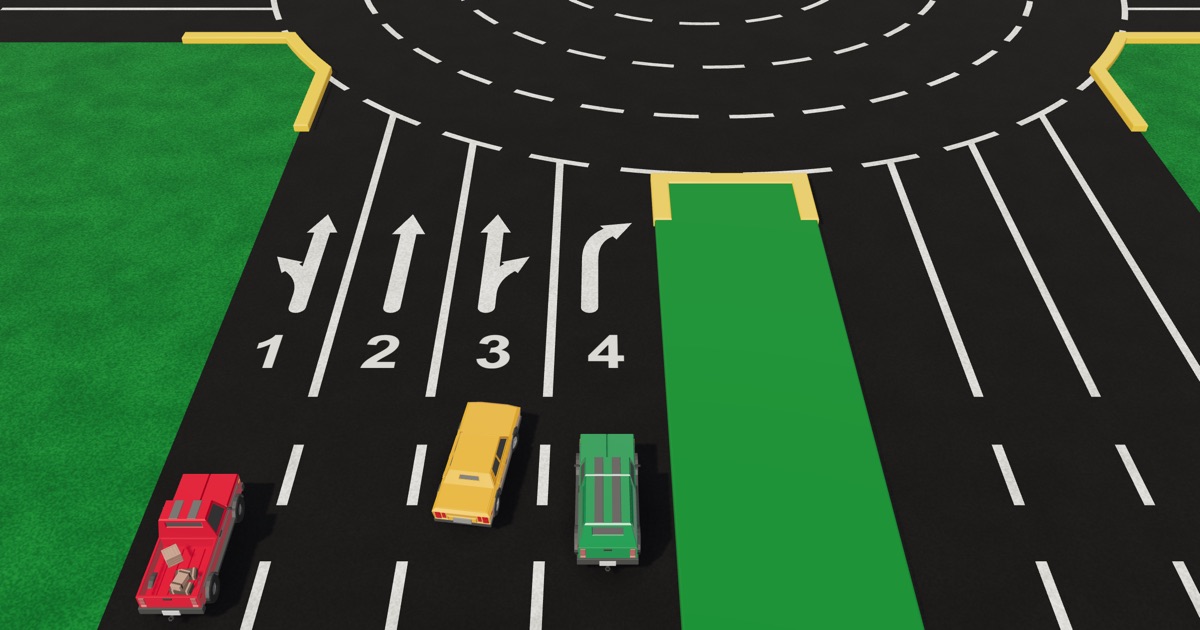
How are the lanes numbered?
From the outermost lane inwards. Lane 1 is beside the kerb, and the highest number is beside the middle of the road.
Learner Driver Handbook, Unit 3: Model Town, p. 11
What do the codes 2124 and 215 mean?
They count the options in each lane, starting at the kerb. On the four-lane road lane 1 has two options, lane 2 one, lane 3 two and lane 4 four. On the three-lane road lane 1 has two, lane 2 one and lane 3 five.
Learner Driver Handbook, Unit 3: Model Town, p. 13
You are on the four-lane road and want to turn left at the roundabout. Which lane?
Lane 1, which turns left at 90°. Lane 4 can also get there, but only the long way round, at 270°.
Learner Driver Handbook, Unit 3: Model Town, p. 13
You want to go straight across the roundabout from the four-lane road. Which lanes can you use?
Lanes 1, 2 or 3, at 0°. Lane 4 can too, but only after going once all the way round, at 360°.
Learner Driver Handbook, Unit 3: Model Town, p. 13
You want to turn right from the four-lane road. Which lanes?
Lane 3 or lane 4, at 90°.
Learner Driver Handbook, Unit 3: Model Town, p. 13
You want to go round the roundabout and come back down the four-lane road. Which lane?
Lane 4, the lane beside the central reserve. Coming back is 180°.
Learner Driver Handbook, Unit 3: Model Town, p. 13
What are lane 4's four options on the four-lane road?
Turn right (90°), come back (180°), turn left the long way round (270°), or go straight after going round clockwise (360°).
Learner Driver Handbook, Unit 3: Model Town, p. 13
Which lane has only one option, on either road?
Lane 2. It goes straight only, at 0°.
Learner Driver Handbook, Unit 3: Model Town, p. 13
You are on the three-lane road and want to turn left. Which lane?
Lane 1, at 90°. Lane 3 can also turn left, the long way round at 270°.
Learner Driver Handbook, Unit 3: Model Town, p. 13
You want to go straight on from the three-lane road. Which lanes?
Lanes 1, 2 or 3, at 0°.
Learner Driver Handbook, Unit 3: Model Town, p. 13
You want to turn right from the three-lane road. Which lane?
Lane 3. It is the only lane on that road that turns right.
Learner Driver Handbook, Unit 3: Model Town, p. 13
You want to come back down the three-lane road. Which lane, and which lane do you come back in?
Lane 3, at 180°. You come back in lane 3.
Learner Driver Handbook, Unit 3: Model Town, p. 13
What are lane 3's five options on the three-lane road?
Go straight; turn right; turn right and enter lane 4 at 90°; come back into lane 3 at 180°; or turn left into lane 3 at 270° and move to lane 4 on the broken line.
Learner Driver Handbook, Unit 3: Model Town, p. 13
How many degrees is each turn at the roundabout?
Straight on is 0°, left and right are 90°, coming back is 180°, the long way left is 270° and once all the way round is 360°.
Learner Driver Handbook, Unit 3: Model Town, p. 13
What do you do before you change lanes?
Mirror, signal, manoeuvre: check your mirrors and your blind spot, signal, then move across. Only where the line is broken.
Learner Driver Handbook, MSM technique, pp. 38 to 39; Learner Driver Handbook, Unit 3: Model Town, p. 10
You are in lane 2 near the roundabout and realise you need to turn right. The lines beside you are continuous. What do you do?
Stay in lane 2 and go straight. A continuous white line means no changing lanes, and lane 2 goes straight only. Then take the longest correct route back to where you were asked to go.
Learner Driver Handbook, Unit 3: Model Town, p. 10; Learner Driver Handbook, Unit 3: Model Town, p. 12
Practise it: level 9, The four-lane road: 2124.
The roundabout
What is a roundabout?
A meeting point where more than two roads meet.
Learner Driver Handbook, Unit 3: Model Town, p. 11
What is a roundabout for?
To let vehicles move in different directions without blocking or hitting each other.
Learner Driver Handbook, Unit 3: Model Town, p. 11
Name the three parts of the roundabout.
The traffic island, the innermost lane (lane 4), and the space (lanes 1, 2 and 3).
Learner Driver Handbook, Unit 3: Model Town, p. 11
What is the traffic island?
The green part in the middle of the roundabout. It controls the movement of vehicles.
Learner Driver Handbook, Unit 3: Model Town, p. 11
Which way do you go round the roundabout?
Clockwise, keeping left.
Learner Driver Handbook, Unit 3: Model Town, p. 11
Who goes first at the roundabout?
Traffic already on it, which comes from your right. Give way before you enter.
Schools differ here. Ask your instructor.
Not in the handbook: a road rule to confirm with your school
Name the five things you must not do on the roundabout.
Stop, change lanes, park, overtake or wait.
Learner Driver Handbook, Unit 3: Model Town, p. 11
You entered in the wrong lane. Can you move across once you are on the roundabout?
No. Changing lanes on the roundabout is not allowed. Choose your lane before you enter.
Learner Driver Handbook, Unit 3: Model Town, p. 11
Which lane may go all the way round?
Only the innermost lane, lane 4 from the four-lane road, may make a full circle (360°). From the three-lane road, only the innermost lane may go as far as 270°. Lanes 1, 2 and 3 may not make a full circle.
Learner Driver Handbook, Unit 3: Model Town, p. 11
Which lane do you leave the roundabout in?
The lane you came round in. Leaving in the wrong lane is one of the common mistakes.
Learner Driver Handbook, Unit 3: Model Town, p. 11
What are the common mistakes at the roundabout?
Approaching in the wrong lane, leaving in the wrong lane, changing lanes on the roundabout, and misreading the traffic lights.
Learner Driver Handbook, Unit 3: Model Town, p. 11
Practise it: level 12, The roundabout rules.
Routes
What are the three route rules?
Take the shortest correct route without using the parking. If you can't, take the longest correct route without using the parking. Use the parking zone as a route only as a last option.
Learner Driver Handbook, Unit 3: Model Town, p. 12
There are two correct routes to where you are going. Which one do you take?
The shorter one, as long as it avoids the parking area.
Learner Driver Handbook, Unit 3: Model Town, p. 12
The only short route cuts through the parking area, but a longer route avoids it. Which do you take?
The longer route. The parking area is a last resort.
Learner Driver Handbook, Unit 3: Model Town, p. 12
The shortest way goes the wrong way down a one-way road. Can you use it?
No. It breaks a rule, so it is not a correct route, however short it is.
Learner Driver Handbook, Unit 3: Model Town, p. 10; Learner Driver Handbook, Unit 3: Model Town, p. 12
When may you drive through the parking zone on your way somewhere else?
Only when there is no other route.
Learner Driver Handbook, Unit 3: Model Town, p. 12
Practise it: level 24, The three route rules.
Signs on the board
What does a Stop sign look like?
A red, eight-sided sign (an octagon) with white letters.
Learner Driver Handbook, Unit 3: Model Town, p. 12
Where is the Stop sign on the board?
At a junction, where you join a two-way traffic road.
Learner Driver Handbook, Unit 3: Model Town, p. 12
There is a Stop sign on your route, but no traffic. What do you do?
Stop anyway. Look right, left, then right again, and go only when the road is clear.
Learner Driver Handbook, Unit 3: Model Town, p. 12
What does a Give way sign look like?
A red triangle with its point facing down and a white border.
Learner Driver Handbook, Unit 3: Model Town, p. 12
What do you do at a Give way sign?
Slow down, or stop if you need to, and go only when it is safe.
Learner Driver Handbook, Unit 3: Model Town, p. 12
What do a triangle, a circle and a rectangle tell you on a road sign?
A triangle warns, a circle gives an order, and a rectangle informs.
Learner Driver Handbook, Unit 2: traffic signs, p. 8
Practise it: level 6, Stop lines, give way lines and crossings.
Parking
What are the two kinds of parking on the board?
Angle parking, also called ample or controlled parking, and flush parking, also called parallel or uncontrolled parking.
Learner Driver Handbook, Unit 3: Model Town, p. 12
Which vehicles may use angle parking?
Small cars only, such as a saloon.
Learner Driver Handbook, Unit 3: Model Town, p. 12
How do you go into and out of an angle parking bay?
Drive in forwards and leave in reverse.
Learner Driver Handbook, Unit 3: Model Town, p. 12
How does traffic move through the angle parking zone?
In one direction. The zone has a set entrance and exit.
Learner Driver Handbook, Unit 3: Model Town, p. 12
Which vehicles may use flush parking?
All vehicles except tractors and trailers.
Learner Driver Handbook, Unit 3: Model Town, p. 12
Where is flush parking?
On the left side of the road, in the direction of traffic.
Learner Driver Handbook, Unit 3: Model Town, p. 12
Why is flush parking called uncontrolled?
It has no security.
Learner Driver Handbook, Unit 3: Model Town, p. 12
How do you go into and out of a flush parking space?
Reverse in and drive out forwards. Leave space for the exit.
Learner Driver Handbook, Unit 3: Model Town, p. 12
Which bay do you take?
The farthest free one, in angle parking and in flush parking.
Learner Driver Handbook, Unit 3: Model Town, p. 12
May you park on the roundabout or beside the yellow kerb?
No. Parking is one of the five things you must not do on the roundabout, and the yellow kerb means no parking, waiting or stopping.
Learner Driver Handbook, Unit 3: Model Town, p. 10; Learner Driver Handbook, Unit 3: Model Town, p. 11
Practise it: level 37, The parking rules.
How to pass the Model Town Board test
NTSA does not publish the test's questions or how it is marked, so no one can promise you a pass. What the handbook does give is the rules every answer rests on. Learners who know these cold do well:
- Know your lane numbers. Lane 1 is by the kerb. Say the number of the lane you are in before you move the car.
- Choose your lane before the continuous lines. Where the lines are broken you may change lanes; once they are continuous you may not.
- Know what each lane may do at the roundabout. The option codes 2124 and 215 tell you, and the arrows painted in each lane show it.
- Go round clockwise and give way to your right. No stopping and no changing lanes on the roundabout.
- Pick the route by the three rules. Shortest correct route first, the longest if a continuous line blocks the short way, the parking area only as a last resort.
- Obey every line and sign on the way. Stop at a stop line, give way at a give way line, and never stop on a crossing.
- Practise on the board you will be tested on, with your driving school.
Now drive it
Answering a question is one thing. Putting the car in the right lane is another. The Model Town Board simulator teaches each rule level by level, then gives you a task, lets you drive it, and tells you which rule you broke. It is free, with no signup.
Your driving school is still the place to practise on a real board, because the test uses a real one.
More on the Model Town Board
- The Model Town Board levelsThe board, the lanes and the rules first. Then you drive.
- Model Town Board diagram, labelledEvery road, lane, line and bay on the board, named.
- Model Town Board lane options: 2124 and 2152124 and 215: which lane may take which turn.
- Model Town Board roundabout rulesClockwise, no stopping or changing lanes, and leaving right.
- Model Town Board rulesThe route rules, lane numbers, lines, kerbs, stop and give way.
- Model Town Board parking: angle and flushAngle and flush parking, and when to use the parking area.
Sources
- Kenya Learner Driver Handbook, compiled by NTSA, 2016: Unit 3, Model Town (pp. 9 to 13), Unit 2 on traffic signs (p. 8) and the MSM technique (pp. 38 to 39). We could not find it on NTSA's own site, so this copy is hosted by a driving school. Ask your school whether your test centre still follows it.