
Trainer № 01 · Recall
Pelican signs
Signs glide past on cards — name each one before it lands. Misses come back sooner; the ones you know drift further apart. Built on how memory actually sticks.
PlayFree · play now
Two quick games that drill the Kenyan road signs until naming one is instant. The full reference is below, the way the NTSA Highway Code lays it out.
Reading the list once is not learning it. These two mini-games make you recall each sign instead; misses come back sooner, the ones you've got drift away. About five minutes a day.
Signs glide past on cards — name each one before it lands. Misses come back sooner; the ones you know drift further apart. Built on how memory actually sticks.
Spin a sign in 3D and read it from any angle — the way you actually see them on Nairobi roads, half-turned and half-lit. Time pressure optional.
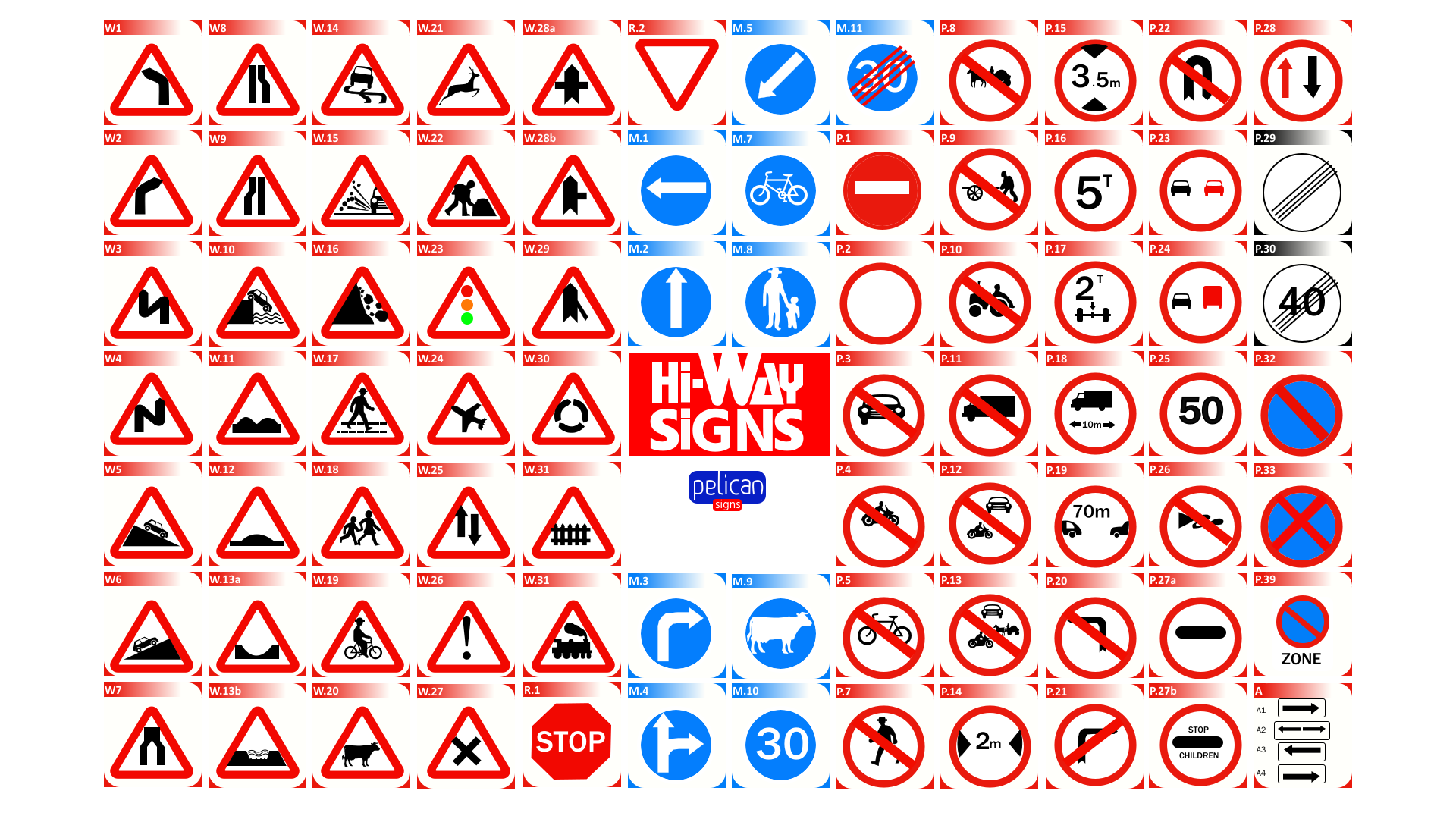
You can read most Kenyan road signs before you can read the symbol on them. Shape and colour do the first job, and the pattern holds across every class.
Tap a class to open it. These are the common signs that turn up on Kenyan roads and in the NTSA test, not the full legal schedule.
Triangle, red border, black symbol on white
Warning signs, Class B in the Highway Code, give you advance notice of a hazard or a change in the road ahead: a bend, a junction, a school, animals, road works. They never tell you to do anything, they tell you to be ready. If it is a red-bordered triangle, slow down and look.
A tight curve ahead. Ease off the throttle before you reach it, not in it.
Bends in succession. The symbol shows which way the first one goes.
A gradient ahead. Lower gear for the climb, control your speed on the drop.
The carriageway narrows on one or both sides. Expect traffic to merge.
A roundabout is coming. Give way to traffic already on it, usually from the right.
A junction ahead where other vehicles can join or cross your path.
A marked crossing is coming. Be ready to stop for people stepping out.
School, playground or children near the road. Slow right down.
Livestock may be on the road, often unaccompanied. Be ready to stop.
Common near parks and reserves. Animals cross without warning, day or night.
The surface can be slippery when wet. Gentle steering, gentle braking.
A hump, dip or rough patch ahead. Slow down before it, not on it.
Loose rock from the cutting above. Watch the road surface as well as the slope.
Works on or beside the carriageway. Expect closures, workers and a lower limit.
Traffic lights are coming. Be ready in case they are red when you arrive.
A railway crosses the road ahead, gated or not. Never queue across it.
You are rejoining a road that carries traffic both ways. Keep left, do not overtake blind.
Calming bumps in the surface. Drop your speed before the first one.
Red ring on a circle, except STOP (red octagon) and GIVE WAY (red triangle)
Prohibitory and restrictive signs are the half of Class A that tells you what you must not do, or sets a limit you must keep: no entry, no overtaking, no parking, a speed or weight limit. They are red-ringed circles, with two famous exceptions. STOP is a red octagon and GIVE WAY a red downward triangle, shaped so you can read them even when faded or seen from behind.
Full stop at the line, every time. Then move off only when it is clear.
Do not enter the junction or roundabout until you will not make other traffic slow.
You may not drive past this point, usually the wrong end of a one-way street.
That manoeuvre is banned at this junction. Carry on or find another route.
Do not pull out to pass until the sign that ends it, or the road clearly allows it.
The number is the most you may do here. It does not mean it is safe to do it.
Cars, matatus, lorries and motorbikes may not use this road.
Lorries over the stated weight, or all goods vehicles, are banned. Take the diversion.
Your vehicle must be under the stated size to pass. Bridges and tunnels especially.
You may not stop on the carriageway at all, even briefly, except in an emergency.
You may not leave the vehicle here. No waiting also covers stopping to wait.
Do not sound the horn here. Common by hospitals and schools.
Walking is not allowed on this stretch, typically a bypass or trunk road.
Blue circle, white symbol
Mandatory signs are the other half of Class A, the positive instruction. A blue circle means you must do what the symbol shows: keep left, turn here, go straight on, use this lane. Blue means do, the red ring meant do not. They turn up most at roundabouts, dual carriageways and one-way systems.
Pass the island, refuge or obstruction on the side the arrow points.
You must turn the way shown at the junction ahead. No straight on.
Straight on is the only legal move here. No turning off.
Turn now, at this point, often where the road is closed straight ahead.
Circulate in the direction of the arrows. Give way as at any roundabout.
You may go left or right of the island ahead.
This lane or road is reserved. Only the vehicle type shown may use it.
A lane or path set aside for bicycles. Other traffic keeps out.
For people on foot, and cyclists where the path is split. Not for vehicles.
Keep up to at least the number shown. Used in tunnels and on fast roads.
Rectangle, blue for facilities, green or white for routes and distances
These are the rectangular signs that help you rather than command you: where you are, where a road goes, where the hospital, parking or matatu stage is, which way a one-way street runs. Blue panels point to facilities and local routes. Green and white-on-black panels carry place names, distances and major-road directions.
Traffic on this street runs one way only, in the direction of the arrow.
Parking is allowed here. Check any plate below for times, fees or who it is for.
A marked crossing where people on foot have priority once they have stepped on.
The official place public-service vehicles pick up and set down. Keep it clear.
A hospital with casualty facilities is signed off this route.
Fuel and roadside services ahead. Useful on long inter-town stretches.
This road does not lead anywhere onward. You will have to come back.
Follow the marked alternative route. The normal road ahead is closed or restricted.
Confirms the route to a town or junction and how far it is.
A toll point is coming on this road. Have payment ready and slow down.
Speed is being checked along here. Your limit has not changed, the watching has.
Red, amber, green, top to bottom
Traffic lights are their own class in the Traffic Act, Class C. The sequence in Kenya runs red, then red-and-amber, then green, then amber, then red. A green light is permission to go only if the way is clear, it never forces you across a blocked junction, and a green arrow lets you go only in that direction.
Stop at the line and wait. Do not cross or edge forward.
Still stop. This is the warning that green is next, do not go yet.
Go, but only if the road beyond the junction is clear and it is safe.
Stop at the line, unless you are so close that pulling up would be dangerous.
You may go in the direction of the arrow even if the main light is still red.
Give way to anyone on the crossing, then proceed when it is clear.
Treat the junction as uncontrolled. Give way as the markings and good sense require.
Painted lines on the road and kerb, white for lanes, yellow for restrictions
Road markings are Class D, and they carry as much authority as a metal sign, sometimes more. White lines organise the lanes and tell you when you may cross. Yellow lines and kerb marks tell you where you may stop or wait. The shorter the gaps in a line, the harder it is warning you.
Lane divider. You may cross it to overtake when the road ahead is clear.
Do not cross or straddle it. Stay your side until it becomes broken again.
Cross only the one nearest you if it is broken, never if the one your side is solid.
Keep out of the painted area. It separates streams of traffic, chevrons especially.
Do not enter unless your exit is clear. Keep the box from locking up.
The line you stop behind at a STOP sign or red light. Do not creep over it.
Stop or slow at this line and give way before joining the major road.
Get into the lane whose arrow matches where you are going, in good time.
Marks the limit of the running surface. Beyond it is shoulder, not lane.
Waiting and loading restrictions apply along the kerb. A plate gives the times.
The painted lane is reserved during the hours shown. Keep out of it then.
Sitting the NTSA test?
Signs are one slice. Practice covers junctions, hazards and the rules too, and the course teaches the lot in order. Free to start.